At the heart of regional NSW, Sparacino Farm is more than just a place that grows avocado and citrus. It’s a family-run operation that was established in 1973 and is currently run by two brothers, Joe and Alf Sparacino.
The family has extensive knowledge about farming and practices ways that make farming more sustainable and productive with their hard work, resilience, and smart decisions.
So, when it came time to tackle rising energy costs, the Sparacinos wanted a solution that would reduce expenses without compromising their values.
With Cyanergy’s smart solution, Sparacino Farm took a strategic step toward energy independence. They planned to install solar panels, thus reducing their dependency on the grid.
For them, this wasn’t just about going solar. It was about making the farm more efficient, more sustainable, and more secure for the future.
With a 99.8 kW solar panel system tailored to their operations, the Sparacino family has cut costs, reduced emissions, and reinvested where it matters most, back into the land that sustains them.
So, if you are thinking of going solar for your business? You’re in the right place.
This blog dives into every detail about how Sparacino Farms Saved Thousands with Cyanergy Solar, how they made it happen, and how you can too.
The Energy Challenge: Rising Electricity Costs on the Farm
Energy expenses are becoming one of the most significant costs for businesses, commercial properties, and farming, and in Australia, most of the residents strongly agree on that.
Agriculture is an energy-intensive industry. Over the years, as machinery has become more advanced and irrigation systems run longer hours, the electricity bill has soared.
For the Sparacino family, the electricity cost had become a significant issue, too.
Like many others, they found themselves facing unsustainable energy costs that were cutting into profits and limiting growth opportunities.
So, faced with rising power bills, the Sparacinos began looking for a long-term, cost-effective energy solution.
Why Solar? | Sparacino’s Motivation for Change!
For the Sparacinos, the decision to go solar wasn’t just about saving money; it was about securing the future of the farm. Also, solar energy made perfect sense, especially in Australia, where abundant sunshine makes it a reliable and renewable option.
Not only this! Investing in solar energy offered several key benefits to them, which include:
- Predictable energy costs.
- Increased energy independence.
- A reduced environmental carbon footprint and lower emissions.
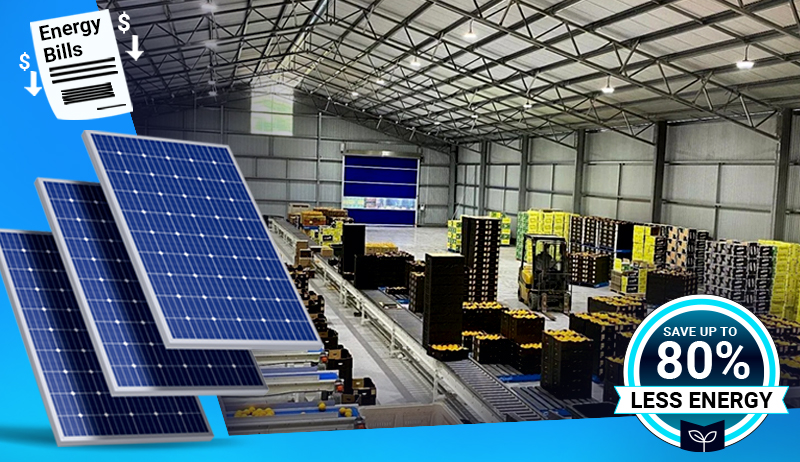
For instance, before going solar, the farm’s annual electricity bill hovered around AUD $48,000, which is a high cost for a mid‑sized agricultural business.
However, after installing solar panels, the bill dropped to $12,000, bringing substantial savings for the Sparacinos.
About Sparacino Farms| Design & Implementation of a Dual System
When the owners of Sparacino farm contacted Cyanergy, our expert team conducted a thorough assessment of the farm’s energy needs and financial goals.
We proposed a hybrid layout that consists of one large system dedicated to the commercial farm operations, and a second system for the residence, expanded with battery storage.
Systems Specifications
So, now let’s have a look at the equipment list and the project snapshot of Sparacino Farm for a detailed concept:
For System 1: Commercial System
- 172 Longi 580W panels
- 2 Sungrow 3-Phase Inverters (one 30KW & one 50KW)
For System 2: Residential System Paired with Battery
- 63 JA Solar 440W panel
- 2 Sungrow 3 Phase 10KW inverter
- 1 Sungrow 19.2KWh Battery
The Power of Smart Farming: Annual Savings Breakdown!
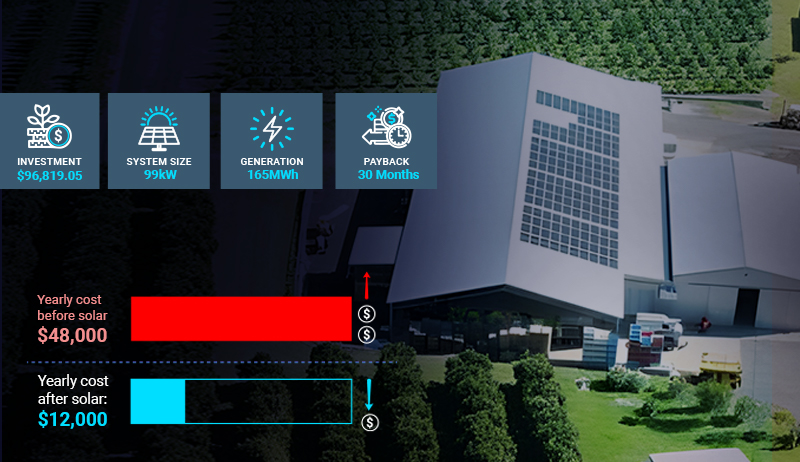
Farming smarter, not harder, and that’s exactly what the Sparacino farm owners did, and their bottom line proves it all.
After installing solar energy, their savings began to add up quickly. Moreover, besides reducing operational costs, they increased long-term sustainability, making their investment worthwhile.
Here’s a closer look at their annual savings, which gives a clear reflection of how impactful the switch to solar has been for the farm.
Financial Impact:
- Before adding solar: AUD $48,000 per year in electricity bills
- After installing solar: around AUD $12,000 per year
- That’s a 75% reduction in energy bills.
- Monthly savings average AUD $3,000
- Projected payback period: 30 months or 2.5 years
After the payback period, every dollar saved is pure gain, drastically improving the farm’s economic resilience.
Other Benefits
- The system generates 165.87 MWh per year in clean energy, significantly reducing reliance on grid-supplied power.
- The residential battery adds flexibility, capturing excess solar power for nighttime use, increasing self-consumption, thus offering energy freedom.
- The system contributes meaningfully to lowering the farm’s carbon footprint, aligning with Australia’s net-zero 2050 emission goal.
From an operations standpoint, the farm now has more predictable energy costs, less exposure to rate hikes, and insulation against volatility.
Project Challenges and Key Takeaways
Even though there were no major hurdles reported in the case materials, from analyzing their approach to solar project experience, we shared a few insights that can be useful for you.
- Accurate energy calculation, modeling, and load profiling are critical
- Proper battery sizing and integration
- Regular monitoring and maintenance
- Look for incentives or regulatory changes.
- Scalability and future growth
If you are planning to go solar, make sure to perform a proper energy audit. Wondering why?
Because, depending on your energy
usage, if your system is oversized or undersized, you either waste capital or fall short of
savings
expectations.
Adding battery storage increases capital cost in any solar setup.
Cyanergy’s choice of a 19.2 kWh battery shows a moderate approach that’s enough to capture excess solar in a
short
time.
For long-term performance and to catch any issues early, real-time or periodic monitoring is essential.
Cyanergy emphasizes real-time performance monitoring in its broader communications.
Australian businesses can generate Small-scale Technology Certificates (STCs) or other incentive mechanisms to offset high energy costs.
At Cyanergy, we help you to understand how these certificates and
subsidy
schemes factor into project viability.
It’s wise to design systems with space or modularity in case demand grows or additional assets require extra
power.
Partnering with Cyanergy: Choosing the Right Solar Experts

The Sparacino Farms case isn’t just a financial win; it’s a milestone for Australians.
It shows that even if you are living in a sector as grounded as agriculture, you can leap forward into innovation.
Their story illustrates a powerful truth that says when you pair vision with technology, backing it with a thoughtful plan, you can turn a solar dream into a profitable reality.
So what are you waiting for?
Join us today and explore all our solar products to find your perfect deal.
Also, check our recent projects on commercial properties to have a clear idea about our services.